
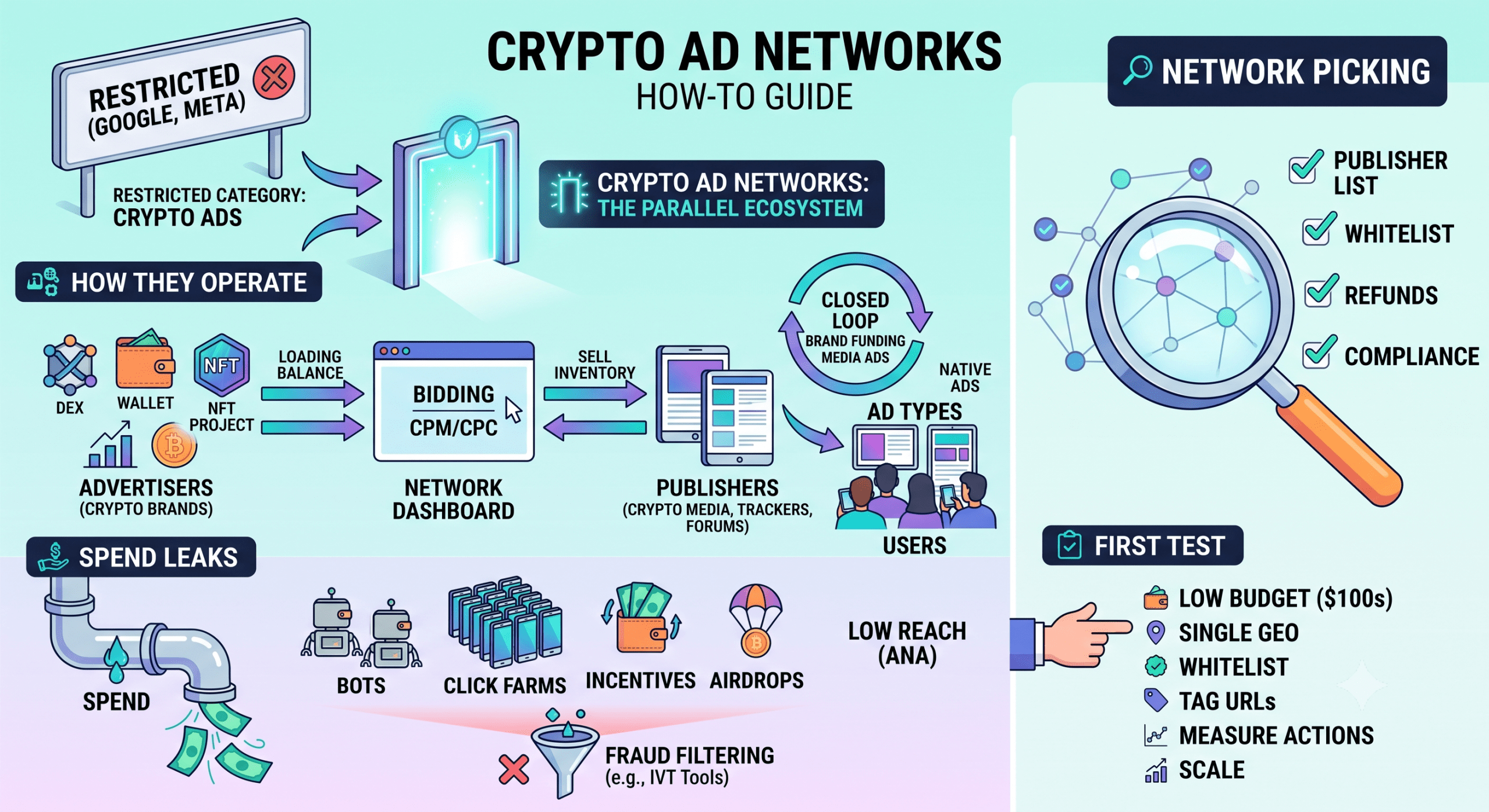
Crypto ad networks exist because the biggest advertising platforms spent years keeping crypto out. When Google and Meta restricted the category, a parallel ecosystem of crypto ad networks grew to serve the advertisers those platforms would not touch. Some of them deliver real audiences at low cost. Others deliver bots wearing wallets. This guide explains how the model works, where the money leaks, and how to test a network without burning a budget.
Why crypto ad networks exist
Mainstream platforms treat crypto as a restricted category. Google, for example, limits crypto advertising to certified exchanges, wallets, and a few other defined products in approved countries, and prohibits ads for ICOs and DeFi trading protocols outright. Certification is per country and tied to local licensing, and other large platforms run similar permission systems. For years that left exchanges, wallets, DeFi apps, and NFT projects with few compliant ways to buy reach.
Crypto ad networks filled the gap by aggregating inventory from crypto media directly. News sites, price trackers, portfolio apps, and forums sell their banner and native slots through networks such as Coinzilla, Bitmedia, and Cointraffic. The audience is self-selected and already interested, and it is reachable without platform certification. That is the pitch, and when the inventory is real, it holds up.
How crypto ad networks operate
Most run on familiar mechanics. Advertisers load a balance, choose formats, and bid on impressions or clicks. Display banners are the volume format, priced by CPM and cheap by mainstream standards. Native placements and sponsored articles cost more and tend to convert better. Push and pop formats are cheaper still and skew low quality. Targeting is mostly contextual and geographic, because the audience is pseudonymous by design; nobody is retargeting a hardware wallet.
Publishers join for the mirror-image reason: mainstream monetization treats crypto content poorly, so selling inventory through a niche network pays better than begging an ad exchange for scraps. The result is a closed loop in which crypto brands fund crypto media. It works well right up until the traffic stops being human.
Payment and reporting quirks come with the territory. Many networks accept crypto alongside card payments, run self-serve dashboards with light creative moderation, and report clicks generously. Treat a network’s own numbers as claims to verify in analytics rather than as results, and reconcile spend against tracked visits weekly while a campaign is still new.
Where the money leaks
Digital advertising leaks money everywhere, not just in crypto. The Association of National Advertisers’ supply chain transparency study found that only around 36 cents of every dollar entering a demand-side platform effectively reaches a consumer, and that made-for-advertising sites soaked up 21 percent of tracked impressions. Crypto ad networks inherit that baseline and add incentives on top: airdrop hunters, paid-to-click farms, and incentive traffic chase anything that pays, while pseudonymous users make verification harder than usual.
The defenses are unglamorous. Insist on a publisher list before spending, not after. Route every campaign through tagged URLs and judge placements on post-click behavior rather than clicks. And filter the paid traffic itself: an invalid traffic tool such as CHEQ sits between the ads and the site, blocking bots and repeat clickers before they drain a daily budget. On low CPM inventory, fraud filtering is often the difference between a channel that works and a channel that merely reports that it works.
How to pick a crypto ad network
A short vetting conversation separates most of the field. Ask which publishers the budget will reach, and whether a whitelist is allowed. Ask where extra volume comes from when campaigns scale, because resold and incentivized traffic hides there. Ask how invalid traffic gets refunded, since a network with no refund policy has no reason to police itself. Ask about compliance: serious networks geo-fence promotions away from strictly regulated markets and ask compliance questions back. Response quality is itself a signal, since a vendor that answers precisely about sources and refunds usually runs cleaner inventory than one that answers with a media kit. Then check minimums; a reasonable network lets a first test run on a few hundred dollars.
Paid display is also just one lane. Sponsored content, PR, and influencer work compete for the same budget, and the notes on hiring a crypto marketing agency cover how those channels get structured and priced against each other.
A first test checklist
- Cap the first campaign at a few hundred dollars and a single geo.
- Run a whitelist of named publishers, never network-wide rotation.
- Tag every URL and compare post-click behavior against the organic baseline.
- Judge placements on session depth and actions, not click-through rate.
- Cut any placement sending zero-engagement traffic within the first week.
- Scale only what still beats the baseline after fraud filtering.
Crypto ad networks FAQ
How much do crypto ad networks charge?
Display CPMs commonly run from under a dollar to a few dollars depending on geo and format, native and sponsored placements cost several times more, and deposit minimums usually start at a few hundred dollars. Cheap is not the goal. Cost per verified human action is the only number that matters, and it only becomes visible after tagging and filtering.
Are crypto ads allowed on Google and Meta at all?
Partially. Google permits certified exchanges, wallets, and a few other products in approved countries while banning categories like ICOs, and Meta runs its own permission process. The rules shift often and differ by country, which is exactly why niche networks keep their place. Any vendor promising a way around platform policy is selling account bans at market rates.
Are crypto ad networks better than influencer marketing?
Different jobs. Networks offer predictable, cheap reach for awareness; influencer work converts belief but is volatile and harder to verify. Funded projects usually run both and hold each to the same standard: what a verified human action costs once the fraud is filtered out. Neither channel deserves a budget it cannot prove.