
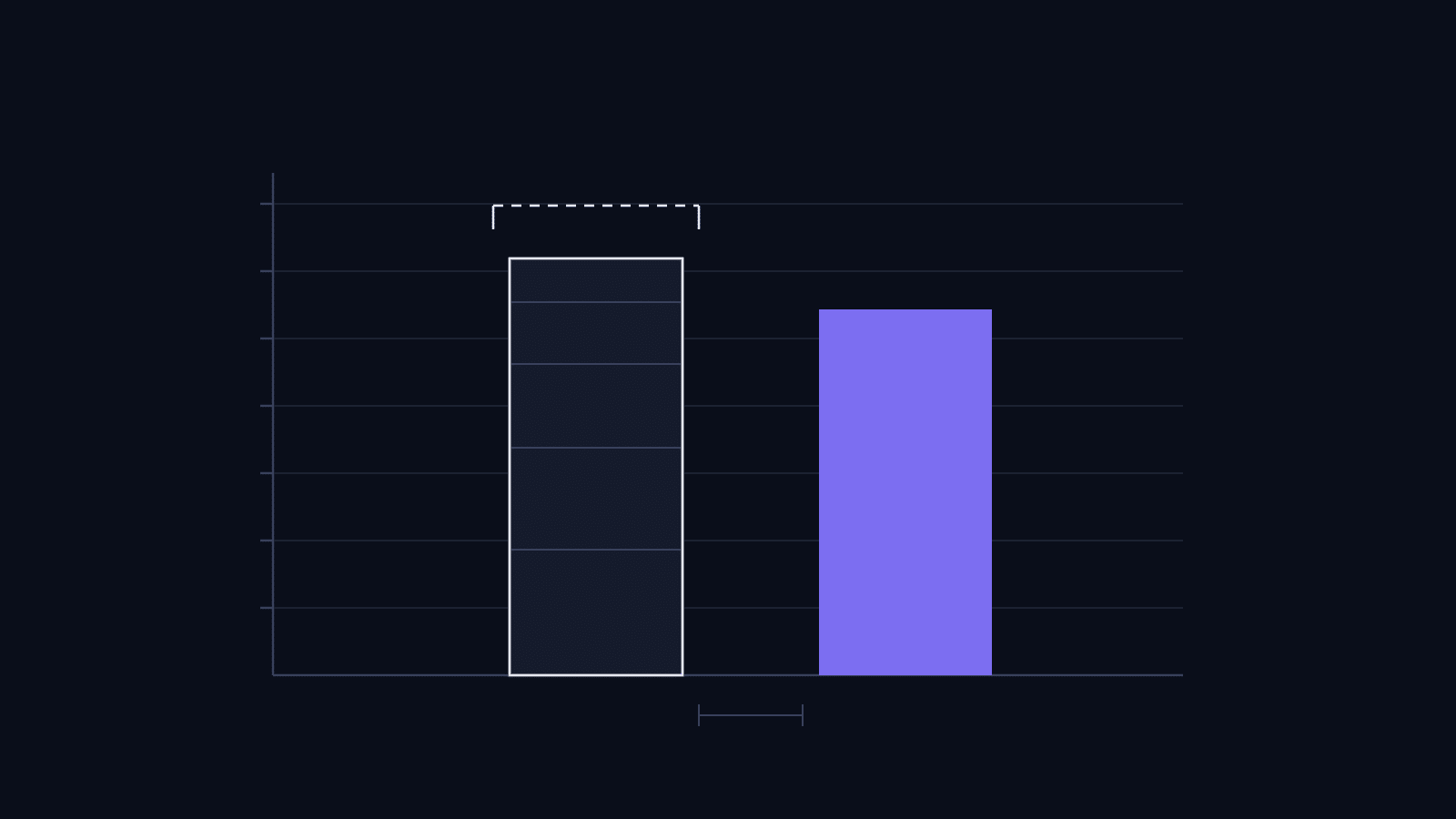
Every founder asks about cost before the first agency call, and the answer that comes back is a retainer range. A crypto marketing budget is not a retainer. The retainer buys a team. Creator fees, media, and placement fees usually sit outside it, and that gap is where most first budgets break.
What a crypto marketing budget cannot borrow from other industries
Outside crypto, marketing spend is set against revenue. Gartner’s 2026 CMO Spend Survey put the average at 7.8 percent of company revenue, barely moved from 7.7 percent the year before. The CMO Survey, run by Duke’s Fuqua School of Business with Deloitte and the American Marketing Association, reads about a point higher because it samples smaller companies. Either figure gives a finance team something to argue with.
A pre-token project has no revenue, so the percentage has nothing to attach to. The number gets set against the raise instead. Agencies that publish launch budgets put it between 6 and 12 percent of the raise for a full launch cycle, which is softer than it sounds: below about 5 percent, projects struggle to be visible at listing, and above 15 percent they are usually buying reach they have nothing to convert with.
The second difference is channel access. Paid search and paid social are closed or heavily restricted for tokens, which removes the cheapest measurable channel most companies start with. Spend moves into creators, community, PR and search, all of which cost more per unit of attention and take longer to read.
What the retainer covers, and what it does not
Published entry prices start between roughly $3,000 and $10,000 a month depending on the agency, and most growth-stage projects land between $10,000 and $25,000 for a full-service scope. Those numbers buy labour: strategy, content, coordination, community management, reporting.
Media is separate. Agencies either add 15 to 30 percent on top of what they pay a creator or fold coordination into the retainer and pass the fee through at cost. Tier-1 crypto publications charge their own placement fees, commonly a few thousand dollars per article, and most retainer quotes exclude them. One question, whether the quote includes creator and placement fees, changes the comparison between two proposals more than anything on the deck, and it is also the question that separates a working crypto marketing agency from a reseller.
The line items
- KOL posts: hundreds to low thousands for nano and micro accounts, low to mid thousands for accounts with six-figure followings, tens of thousands for a top-tier campaign.
- Press release syndication: from about $200. Syndication is distribution, not coverage, and the two get conflated in proposals.
- Editorial placement in tier-1 crypto media: low thousands to five figures per article, quoted separately from the retainer.
- Community management across Telegram and Discord: priced by hours of coverage and number of platforms, not by member count.
- Search and content: a monthly retainer with returns that compound across quarters rather than weeks.
- Audit and trust assets: not marketing, but they come out of the same pot in practice, and leaving them out understates the launch number by a wide margin.
The number that matters is not the invoice
Cost per thousand people reached is the comparison worth running, because it is the only way to put a $500 Telegram post and a $20,000 YouTube segment on the same axis. Crypto rates run several times higher than general consumer creators at the same follower count, which is defensible when the audience holds and trades and indefensible when it does not.
That is where the money goes missing. A large share of crypto follower counts are bought, and a $3,000 post that reaches traders looks identical to a $3,000 post that reaches bots until referral data arrives weeks later. The case for paying an agency rests on the vetting rather than the posting, which is also why the cheapest quote in a stack of three is rarely the cheapest outcome.
A checklist before you approve the budget
- Ask whether creator and placement fees sit inside or outside the retainer, and get the answer in writing.
- Ask what markup applies to pass-through spend, as a number rather than a description.
- Set a floor you can sustain for six months instead of a launch spike you cannot repeat.
- Require referral or wallet-level attribution on every paid placement before the second invoice.
- Hold back 10 to 20 percent of the monthly number for whichever channel works, and expect to find it in month two or three.
- Budget the audit separately, so trust spend is not competing with reach spend.
Crypto marketing budget FAQ
How much does crypto marketing cost per month?
Published pricing clusters between about $3,000 and $50,000 a month, with most growth-stage projects between $10,000 and $25,000 for a full-service scope. The spread reflects scope and, more than anything, whether media sits inside the quoted number.
What share of a raise should go to marketing?
Agencies that publish launch budgets put it at 6 to 12 percent of the raise across the launch cycle. Below 5 percent, visibility at listing is hard to buy. Above 15 percent, spending tends to outrun what the product can convert, which shows up as a traffic spike and a flat holder count.
Is a package cheaper than a retainer?
Per item, yes. Packages work when you already know which items you need. A retainer buys the judgment about which items to buy in what order, and that judgment is the part that is hard to purchase a la carte.